
LarissaNet reports on the University of Thessaly’s historic decision to establish an English-taught medical program, welcoming international students to Larissa.
17 May 2022 | Larissanet.gr
The Department of Medicine at the University of Thessaly is set to introduce a new English-taught undergraduate medical program.
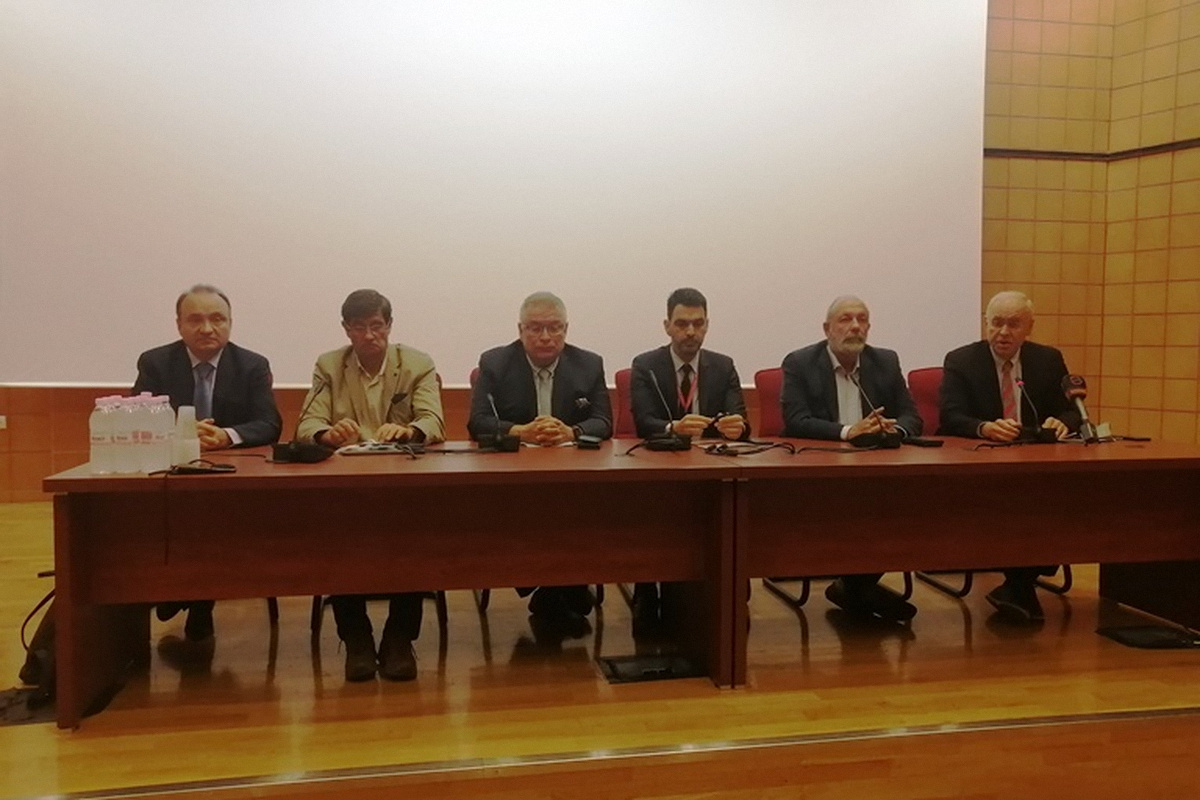
Representatives of the University’s academic community presented the details of this historic development at a press conference held earlier today.
Professor Athanasios Giannoukas, President of the Department of Medicine at the University of Thessaly, stated:
“The Senate of the University of Thessaly approved the Department of Medicine’s decision to establish an English-taught undergraduate program in Medicine. In other words, an English-taught medical program within a public university.
The program is intended for graduates of secondary schools abroad and is not addressed to students from Greece. Admission will involve an application process, followed by an evaluation of applications and examinations, enabling us to select the most qualified candidates.
We do not regard students as customers. We consider this initiative historic, as it will open new avenues for international engagement, the dissemination of scientific knowledge, and the development of international collaborations.
It will make it easier for international students to come and study here, while also creating opportunities for our own students to participate in Erasmus exchange programs abroad.
Highly qualified young academics will be recruited to teach in both the English-taught and Greek-taught medical programs, and new research activities will be developed. Emeritus professors and honorary doctorate holders will also be invited to contribute to teaching.
The initiative will also bring significant benefits to the University Hospital, contributing to the enhancement of its services.
Looking towards the future, this initiative is the best way to honour our past and the 30th anniversary we celebrated last year.
Furthermore, this initiative by the University of Thessaly and its Department of Medicine will bring considerable benefits to the local community, as international students will come to live in the area, generating economic activity.
Most importantly, however, is our history. The Hippocratic legacy is a defining element of our identity and a significant attraction for students who choose to study Medicine here.
We will share Greek culture with these students, who, upon returning to their home countries, will become ambassadors of our cultural heritage.
Our ambition is to welcome our first students in the 2023–2024 academic year.”
Professor Zisis Mamouris, Rector of the University of Thessaly, commented:
“This is a historic day for the University of Thessaly. It opens a new path for the University and takes its academic activities to an entirely different level.
There are still many challenges to overcome before the initiative can be fully implemented. Nevertheless, I am confident that it will serve as an example for other faculties to follow.
I believe this will be the fourth English-taught program of its kind in Greece, and I am certain it will be highly successful.
It will raise the profile of both the region and the University of Thessaly, while providing faculty members, researchers, and students with opportunities to pursue careers beyond traditional academic pathways.”
Professor Theofilos Karachalios, Professor of Orthopaedics and Coordinator of the Working Group, stated:
“Following its merger with the Technological Educational Institutes, the University of Thessaly has become the fourth-largest university in Greece. It is our collective responsibility to continue moving forward.
This is a historic moment, although perhaps one that should have come sooner. There are successful examples of similar programs abroad, particularly in the United Kingdom.
This program does not compete with Greece’s national university entrance examination system. It is an English-taught program offered by a public university, not a private institution, and it does not compete with the existing Greek-taught medical program.
Larissa has a highly attractive combination of advantages to offer. Beyond its history and its association with Hippocrates, the city provides a safe environment for students.
The Greek-taught medical curriculum was recently modernized, and this updated curriculum has been translated and adapted for the English-taught program.
I believe other faculties will follow this example.”
Professor Alexandros Daponte, Professor of Obstetrics and Gynaecology and a member of the Working Group from Aristotle University of Thessaloniki, noted:
“Public universities in Greece have undergone considerable reflection about their identity and future. Like society itself, they are increasingly embracing international engagement.
In Thessaly, it would be a missed opportunity not to recognize our advantages and share our knowledge with others.
We are not competing with the Greek higher education system. We are simply expanding educational opportunities and creating something new.
It is extremely important for both the university community and the city to embrace this initiative and give it the opportunity it deserves.
Thessaloniki was the first to undertake a similar initiative, receiving 950 applications and attracting interest from 20 countries. This demonstrates the multicultural nature of the demand, and I believe we can offer something equally valuable here.”
Professor Dimitrios Bogdanos, Representative of the Department of Medicine on the University of Thessaly’s Quality Assurance Unit and Director of the Division of Internal Medicine, emphasized:
“The Department of Medicine ranks among the top 300 worldwide and among the top 150 medical schools in Europe.
As a department, we have a responsibility to establish an English-taught medical program.
We have studied the mistakes made by institutions that have developed similar programs around the world so that we can avoid repeating them.
Compared with the other seven medical schools in Greece, the Department of Medicine at the University of Thessaly has demonstrated the greatest progress.
The establishment of the English-taught program will further strengthen the Department’s international outlook.”
Professor Ioannis Tsoungos, Vice President of the Department of Medicine, stated:
“I believe this will be a highly positive development for the University, the city of Larissa, and the wider region of Thessaly, including the University Hospital of Larissa.
The English-taught program will be self-funded through tuition fees paid exclusively by international students, amounting to €12,000 per year.
I encourage the local community of Larissa to warmly welcome these students, ensuring that the benefits of the program extend beyond the University to the city and the entire region of Thessaly.”
Program Capacity and Next Steps
The maximum planned intake for the program is 40 students, subject to demand and the availability of suitable teaching facilities. Additional teaching spaces have already been created to accommodate the new program. Following approval by the Hellenic Authority for Higher Education (HAHE), the University will proceed with the necessary steps to publish the official call for applications, with 2023 set as the target year for the program’s launch. The University of Thessaly will thus become the first regional university in Greece to establish an English-taught undergraduate program of this kind.
 English
 Greek